CD Interest Calculator: Calculate APY, Interest & Maturity
Estimate certificate of deposit maturity value, periodic compound interest, APY earnings, and complete growth schedule.
| Period | Starting Balance | Interest Earned | Ending Balance |
|---|
Share this exact CD calculation link, send to social platforms, or scan the QR code.
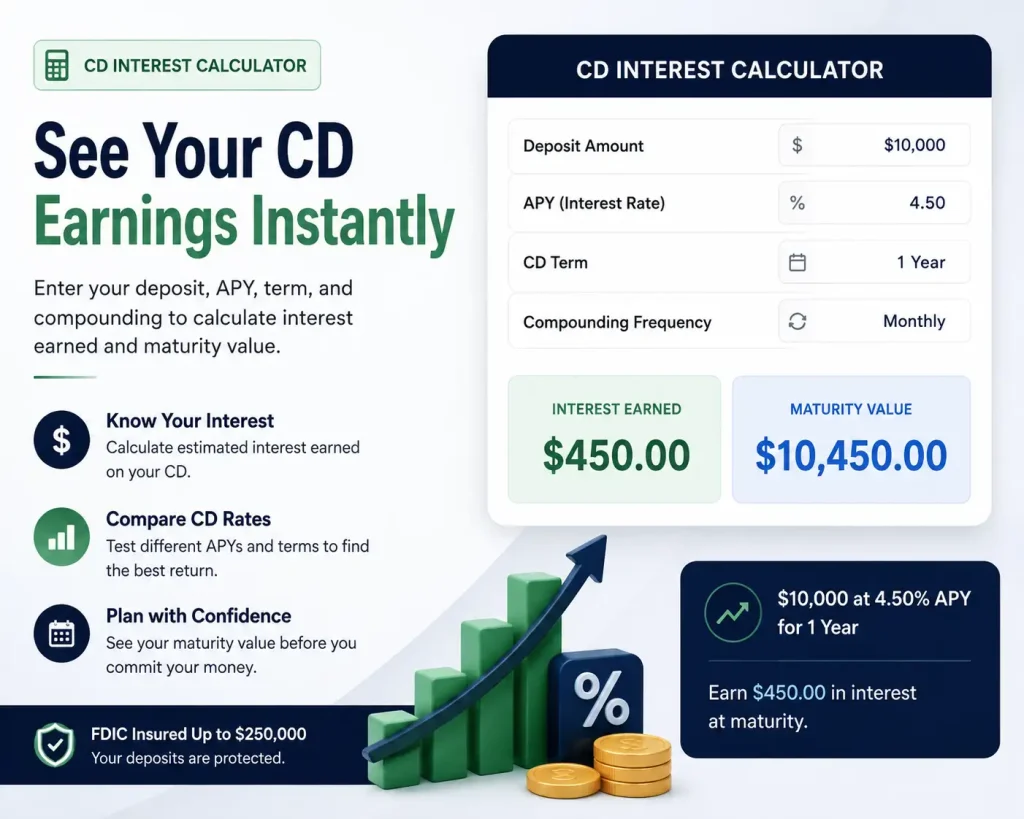
If you put $10,000 into a CD earning 4.50% APY for one year, you would earn about $450 in interest. Your balance at maturity would be $10,450. A CD interest calculator gives you this kind of answer instantly, using your deposit amount, your rate, your term, and how often the bank compounds interest.
This tool is built for anyone who wants a real number before opening a CD, not a rough guess. You enter what you plan to deposit, the APY your bank is offering, and how long you plan to lock the money in. The calculator returns two things: the interest you can expect to earn and the total value of your CD at maturity. From there, you can compare offers, test different terms, and see how a higher rate or longer term changes your return.
How to Use the CD Interest Calculator
The calculator only needs a few pieces of information to give you an accurate estimate.
Enter Your Initial Deposit
This is the amount of money you plan to put into the CD when you open it. Most banks set a minimum deposit, often between $500 and $2,500, so check your bank’s terms before you enter an amount below that range.
Enter the CD interest rate or APY
Use the APY listed on your bank’s CD, not just the stated interest rate. APY already includes the effect of compounding, so it gives you a more accurate picture of what you will actually earn in a year.
Choose the CD term
CD terms usually run from 3 months to 5 years. Longer terms often come with higher rates, but your money stays locked in for the full term unless you pay an early withdrawal penalty.
Select the Compounding Frequency
Banks compound CD interest daily, monthly, or quarterly. If you already have the APY, you don’t need to worry about this step, since APY reflects the compounding your bank already applies.
Review Your Estimated Earnings
The calculator shows your total interest earned and your maturity value, the amount you’ll have once the CD term ends.
How Is CD Interest Calculated?
You calculate CD interest by multiplying your deposit by the APY and the length of the term. For a one-year CD, the formula is simple: interest earned equals principal times APY. A $10,000 deposit at 4.50% APY for one year earns $450, giving you a maturity value of $10,450.
For terms longer than a year, the calculation compounds on itself. Each year, interest is earned not just on your original deposit but also on the interest already added to your balance. A $10,000 CD at 4.50% APY held for two years grows to $10,920.25, not a flat $10,900, because the second year’s interest is calculated on $10,450, not $10,000.
APY makes this calculation easier because it already accounts for how often your bank compounds interest. Whether your bank compounds daily or monthly, the APY reflects the actual annual return you’ll earn, so you can use it directly without doing separate compounding math.
How Much Interest Can You Earn on a CD?
The amount of interest you earn depends mainly on your deposit size, your APY, and your term. Here’s what a 4.50% APY, one-year CD would earn at three common deposit amounts:
| Deposit | APY | Term | Interest Earned | Maturity Value |
|---|---|---|---|---|
| $1,000 | 4.50% | 1 year | $45 | $1,045 |
| $5,000 | 4.50% | 1 year | $225 | $5,225 |
| $10,000 | 4.50% | 1 year | $450 | $10,450 |
A larger deposit earns proportionally more interest at the same rate and term, since interest is calculated as a percentage of your principal. A longer term earns more total interest, since your money has more time to compound. And a higher APY earns more interest even if the deposit and term stay the same, since APY is the percentage applied to your balance each year.
What Affects How Much Interest a CD Earns?
Deposit Amount
A larger deposit earns more interest in dollar terms, even though the rate and term stay the same.
APY or Interest Rate
A higher APY increases the interest earned when the deposit amount and CD term stay the same. Even a small difference, like 4.25% versus 4.75%, adds up over a longer term.
CD Term
Longer terms give your money more time to compound, which increases total interest earned, assuming the rate doesn’t change.
Compounding Frequency
More frequent compounding, like daily instead of monthly, slightly increases your effective return, which is why APY already builds this into a single number.
Early Withdrawal
Taking money out before the CD matures usually triggers a penalty, often equal to several months of interest. This can reduce your total return below what the calculator estimates for the full term.
CD Interest vs. APY
A CD’s stated interest rate and its APY are not always the same number. The interest rate is the base rate the bank pays, while APY reflects the total return after compounding is applied over a year. When a bank compounds interest more than once a year, the APY will be slightly higher than the plain interest rate.
For example, a CD with a 4.40% interest rate compounded monthly has an APY of about 4.49%. On a $10,000 deposit, that difference means earning roughly $449 instead of $440 over one year. This is why comparing APY to APY, not rate to rate, is the accurate way to compare CDs from different banks.
CD Maturity Value and Total Interest Earned
Maturity value is your original deposit plus all the interest it earned during the term. It’s the total amount you receive when the CD ends, whether you withdraw it, reinvest it, or roll it into a new CD.
A $5,000 CD at 4.50% APY for one year earns $225 in interest, giving it a maturity value of $5,225. The calculator shows both numbers separately, so you can see your original deposit, your earnings, and your final balance without doing the math by hand.
Can You Calculate CD Interest Without a Calculator?
Yes. You can estimate CD interest using the deposit amount, APY, and term. For a one-year CD, multiply your deposit by the APY. For a CD longer than one year, use this formula: maturity value equals principal times (1 plus APY) raised to the number of years, assuming the same rate applies each year.
As an example, a $2,000 deposit at 3.75% APY for three years grows to about $2,233.54 at maturity. That’s $233.54 in total interest, earned because each year’s interest is calculated on the previous year’s growing balance, not just the original $2,000.
Common CD Interest Calculation Mistakes
Confusing APY with a simple interest rate is one of the most common mistakes. APY already includes compounding, so applying it as if it were a flat, uncompounded rate can throw off a multi-year estimate.
Ignoring the CD term is another common error. A rate that looks attractive for five years earns far less in year one alone, so the term always has to be part of the calculation, not just the rate.
Forgetting the effect of early withdrawal penalties is a mistake that shows up after the fact. A calculator estimate assumes you hold the CD for its full term. Withdrawing early can erase weeks or months of earned interest.
Assuming every bank uses identical terms can also lead to inaccurate comparisons. Minimum deposits, compounding frequency, and penalty terms vary by bank, so two CDs with the same advertised APY don’t always work the same way in practice.