How Much Interest Can I Earn on a CD?
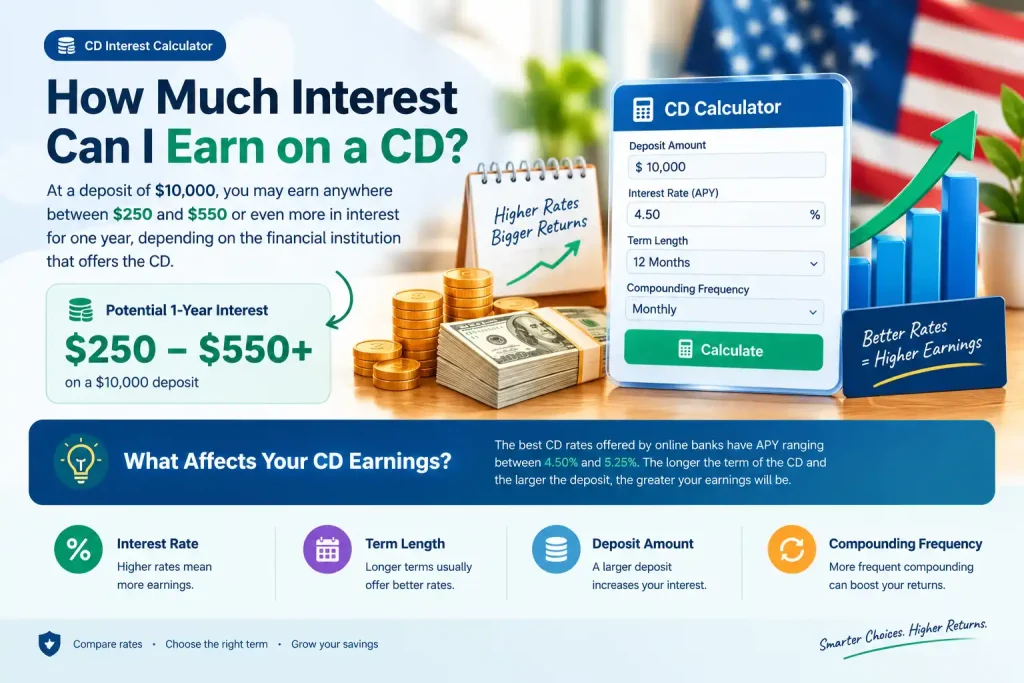
At a deposit of $10,000, you may earn anywhere between $250 and $550 or even more in interest for one year, depending on the financial institution that offers the CD. The best CD rates offered by online banks have APY ranging between 4.50% and 5.25%. The longer the term of the CD and the larger the deposit, the greater your earnings will be.
Interest rates have shifted more in the past three years than in the previous decade combined. When I track how Certificate of Deposit rates move alongside Federal Reserve decisions, one pattern always holds: savers who understand CD mechanics capture the best returns. Those who do not leave real money on the table.
How CD Interest Actually Works
The certificate of deposit is a type of time deposit. It is a situation where you give the bank some amount of money for a certain period, like 6 months, 1 year, 3 years, and even more. In return, the bank will pay you interest. Two numbers matter most: the interest rate and the APY.
Interest Rate and APY
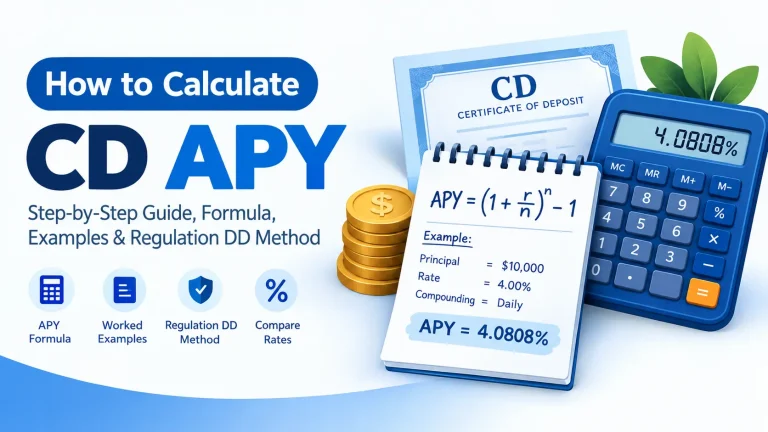
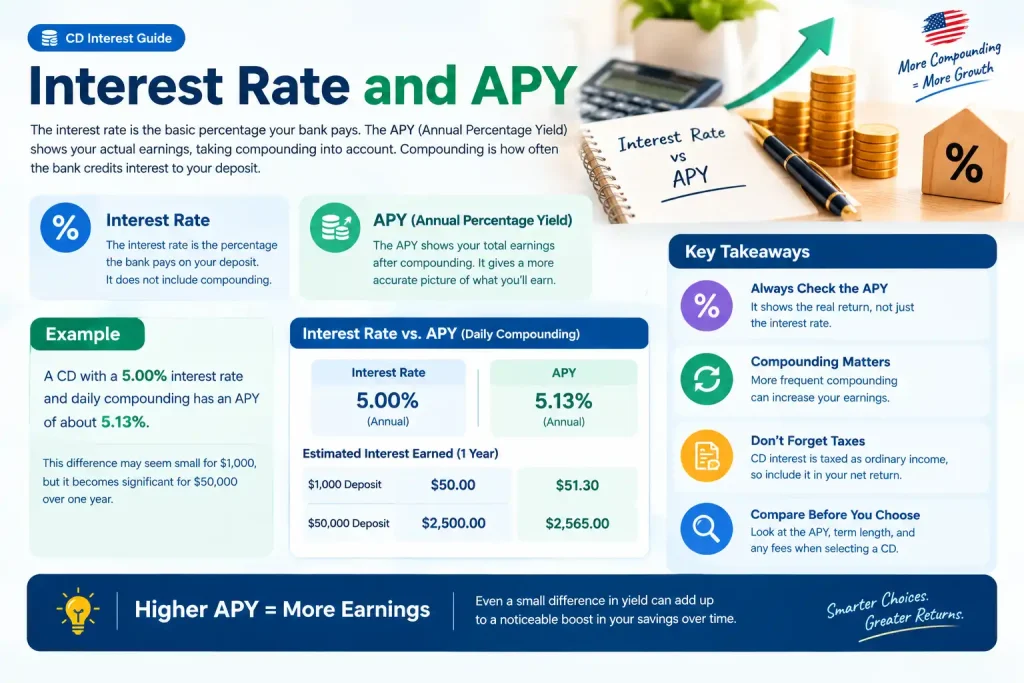
The interest rate is the basic percentage at which the bank will pay on your deposit. The APY, or Annual Percentage Yield, will show you what you will earn, taking into account compounding. Compounding is the frequency with which the bank will credit interest to your deposit.
Below is a very basic example. The annual percentage yield for a CD with an interest rate of 5.00% compounded daily is about 5.13%. This difference may be insignificant for $1,000 but becomes considerable for $50,000 over one year.
When comparing CDs, always remember to look at the APY that is, the true interest rate. And here is something else: interest from CDs is taxed as ordinary income, so it should be taken into account when calculating the net return.
Real Numbers: What a $10,000 CD Earns
The table below shows estimated earnings on a $10,000 deposit across different CD terms, using competitive APYs available at online FDIC insured banks as of mid-2026. These figures assume interest compounds daily.
| CD Term | Competitive APY | Interest Earned | Total at Maturity |
|---|---|---|---|
| 6-Month | 4.75% | ~$237 | ~$10,237 |
| 1-Year | 5.00% | ~$500 | ~$10,500 |
| 2-Year | 4.60% | ~$941 | ~$10,941 |
| 3-Year | 4.40% | ~$1,379 | ~$11,379 |
| 5-Year | 4.20% | ~$2,305 | ~$12,305 |
These are competitive rates – definitely not what you would get if you were to put your money at a traditional brick-and-mortar institution, which typically pays an APY in the range of 0.50%-1.50% on the same terms.
It is very simple math. Multiply your principal times your APY and take into consideration the term. If you do not feel like calculating, you may use a CD interest calculator and input your own numbers for the deposit and the interest.
What can we conclude? Shorter terms offer higher interest right now. This is somewhat unusual as normally longer terms pay more. Short-term rates paying more than long-term ones indicate falling interest expectations of the market.
The Trade-offs You Need to Know
CD interest looks clean on paper. The trade-offs are real.
Early Withdrawal Penalty
When you open a CD, you commit to keeping your money in place until maturity. Pull it out early and you pay an early withdrawal penalty.
Penalties vary by bank and term. Common examples:
On a 1-year CD earning $500, an early withdrawal could wipe out $250 or more of that gain. In some cases, especially if you withdraw very early, you can lose a portion of your principal too.
Before opening a CD, ask yourself honestly: will I need this money before the term ends? If there is any real chance you will, a high-yield savings account gives you flexibility without the penalty. You can also use a CD early withdrawal penalty calculator to see exactly what breaking your CD early would cost you.
Inflation Risk
Here is the question people skip: are you actually growing your purchasing power, or just keeping up?
If a CD pays 4.50% APY and inflation runs at 3.50%, your real return is about 1.00%. That is still positive. In years when inflation outpaces your CD rate, your money technically grows on paper while losing ground in the real world. CDs are not a wealth-building tool. They are a preservation and yield tool. Understanding that distinction helps you use them correctly.
Strategies That Work
CD Laddering
CD laddering is a great solution to both problems since it ensures that not all of your money will be tied up to one interest rate while allowing you to access part of your cash flow periodically.
Here is how a basic ladder works with $20,000:
- Put $5,000 in a 1-year CD
- Put $5,000 in a 2-year CD
- Put $5,000 in a 3-year CD
- Put $5,000 in a 4-year CD
Each year, one CD matures. You take that money and either spend it or roll it into a new 4-year CD. Over time, you hold four CDs at different stages, and one always matures within 12 months. This approach means you are never fully locked out of your savings. It also means you catch rate increases as they happen, rather than sitting in a single long-term CD while better rates appear.
Online Banks and Traditional Banks
From my time comparing bank interest rates, it has never been hard to spot the difference between online banks and traditional banks. The FDIC-insured online banks pay annual percentage yields that are three to five times more than those paid by big banks with bricks and mortar on similar CDs. And there is a good reason why lower costs at the online banks mean better savings for depositors.
The disadvantage is the absence of a physical branch. But for most people who only care about their returns, it is an easy compromise. Always check to see whether the bank you are using is FDIC insured. You will be assured of getting your money up to $250,000 for each account type in case the bank goes under.
Run the numbers yourself before signing anything. You can find an online CD interest calculator that will calculate your deposit amount, the APY of the particular bank, and the term of your account. See how much money you would make.
Compare at least three banks. Rates fluctuate weekly. The best CD rate that is currently offered by a particular bank might not be the same next month.
If you are interested, the website Its CD Calculator offers a free CD calculator and a CD ladder calculator. They are designed in such a way that you can run the scenarios within less than two minutes.