
Cubic Yard Calculator – Calculate Cubic Yards
Find out how many cubic yards of concrete, gravel, sand, topsoil, or mulch your job needs for slabs, footings, round columns, or stairs — plus how many bags that means, an estimated weight in tons, and a heads-up on small-load delivery fees.
Assumes solid-fill stairs poured on level, compacted ground (a stepped solid block, not a hollow shell).
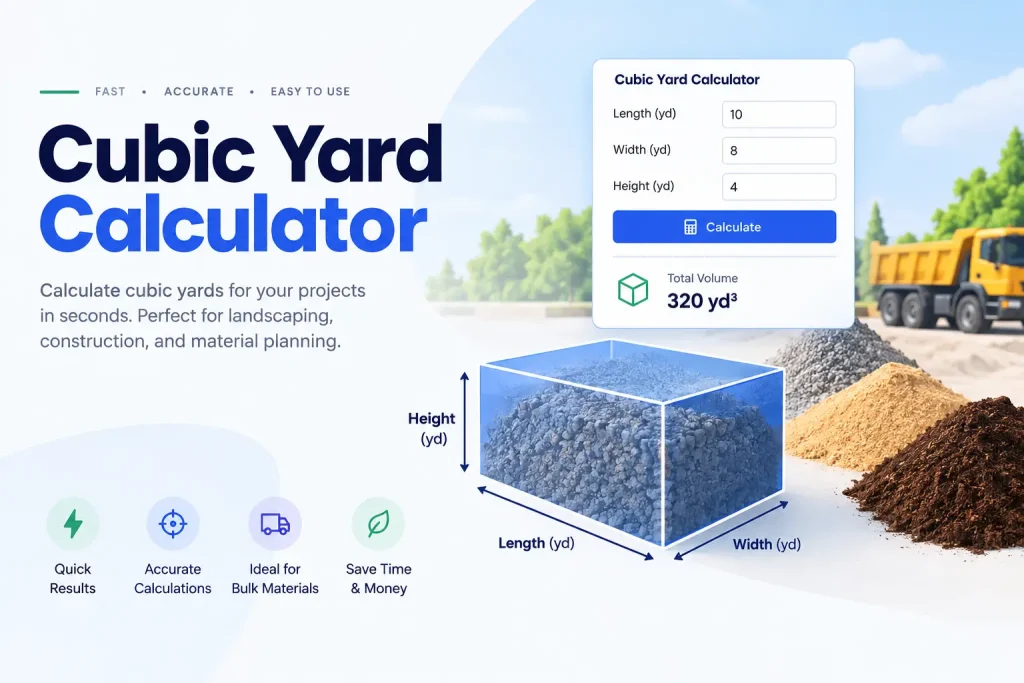
Estimating the amount of topsoil, gravel, or concrete needed is risky; doing so can blow your budget halfway through the job. A cubic yard calculator solves this by providing a precise figure. Allowing you to call your supplier with confidence right away. If you’ve ever stood before a pile of mulch wondering if you ordered enough, you already understand why this matters.
Below, you will find the simple formula behind any cubic yard calculator. You will learn how to accurately measure your space and make the real-world adjustments that most apps overlook. You can find this guide along with many other free tools for various projects at CD Calculator.
Cubic Yard Formula
Here’s the formula, no filler.
A cubic yard covers 27 cubic feet of space. Whether you’re figuring out how to calculate a cubic yard of mulch or a full concrete pour, the formula stays the same. Measure length, width, and depth in feet, multiply, then divide by 27.
What Is a Cubic Yard?
A CD ladder is a simple way to save: instead of putting all your money into one ceA cubic yard is a block of material 3 feet long, 3 feet wide, and 3 feet tall. That’s 27 cubic feet total, and it’s the baseline most cubic yard calculator tools are built around.
What does that actually look like on site?
If your supplier says a load is “one yard,” picture that box. It helps more than any number on a screen.
How to Calculate Cubic Yards Step by Step
Start with money you’re comfortable putting away for a while. Keep your emergency fund separate. A CD ladder works best with savings you don’t need right away, since even the shortest rung ties up your cash for months.
Convert Inches to Feet First
This is where most orders go wrong. Depth almost always comes in inches. Mulch at 3 inches, gravel at 4 inches, a concrete slab at 4 to 6 inches. Divide the inch measurement by 12 to get feet.
Example: 4 inches ÷ 12 = 0.33 feet
Skip this step and your total comes out way off, sometimes 12 times too high or too low.
Plug In the Numbers
Example: A 20 ft by 10 ft garden bed at 3 inches (0.25 ft) deep. 20 × 10 × 0.25 = 50 cubic feet 50 ÷ 27 = 1.85 cubic yards
How to Calculate Cubic Yards from Square Feet
Already know your square footage? Skip straight to this.
Cubic yards = (Square feet × Depth in feet) ÷ 27
A 500 sq ft yard at 4 inches deep: 500 × 0.33 = 165 cubic feet, then 165 ÷ 27 = 6.1 cubic yards. Any cubic yard calculator online is running this same math behind the scenes.
Calculating Cubic Yards for Non-Rectangular Areas
Not every job site is a clean rectangle. The formula adjusts, not disappears.
Break the space down before you measure. It’s faster than trying to force one formula over an odd shape.
Cubic Yards by Material
Concrete
The formula never changes. What changes is how the material behaves once it hits the ground.
Mulch and Soil
Loose materials settle. Order for the volume you want after settling, not before. Topsoil and mulch typically lose 10 to 20 percent of their volume within the first few weeks, so a straight soil calculator cubic yards figure needs a bump. If you’re planning new beds at the same time, our Grow a garden calculator helps you map the planting space before you commit to a fill order.
Gravel and Aggregate
Gravel compacts hard once it’s driven over or rolled. If your supplier prices by weight instead of volume, gravel runs roughly 1.4 to 1.7 tons per cubic yard depending on stone size. This is where a tons to cubic yards calculator earns its keep. Always confirm the density number with your supplier before converting.
Big gravel orders aren’t cheap, so it’s worth knowing where your project cash is sitting before you commit to it. A CD APY calculator shows you which savings option actually earns the most while you wait on the delivery date.
Concrete
Concrete gets no slack. Calculating cubic yards of concrete uses the same formula, but you order the exact amount plus a small buffer, never round down. A short pour means a second truck, a delay, and a cold joint you didn’t want.
If you’ve got funds parked away for the pour, timing matters. A CD maturity calculator tells you exactly when that money frees up, so you’re not stuck waiting on a bank while your crew is standing around.
US, Canada, and UK: Converting Between Units
Cubic yards are standard across the US construction and gardening trade. Cross the border or the ocean and the terms shift.
Working from a UK or Canadian quote in cubic meters? Multiply by 1.31 before you type the number into a cubic yard calculator built for US measurements.
Comparing units across countries is exactly the kind of side-by-side math a CD comparison calculator does for savings accounts, laying every option out so you can pick the one that works best for your timeline.
The Contractor’s Waste Margin
Here’s something no app tells you. Order the exact mathematical number and you will come up short. Every time. The ground isn’t perfectly flat. Piles settle in the truck on the drive over. Material spills off the shovel or wheelbarrow before it hits the ground. On a driveway job a few seasons back, we measured twice, ordered exact, and still had to call for a top-up delivery because the base course settled more than the math accounted for. Add the buffer before you order, not after you run short.
Recommended overage by project:
| Material | Add This Much |
|---|---|
| Mulch and topsoil | 10% |
| Gravel and aggregate | 10–15% |
| Concrete | 5–10%, never round down |
| Sloped or irregular ground | 15% minimum |
That extra buffer money doesn’t have to sit idle either. A CD interest calculator shows what a reserve like that can earn while it waits to be spent on the top-up order.
Big renovation spread across several months instead of one order? A CD ladder calculator keeps portions of your budget accessible at different points instead of locking it all away at once.
Common Mistakes When Calculating Cubic Yards
Getting the rate wrong isn’t just a construction problem either. People make the same kind of error when they skip a step figuring out returns on savings, which is exactly what our how to calculate CD rates guide walks through.
Frequently Asked Questions
Once your material order is locked in, the next number worth getting right is what your project savings are actually earning. Our how to calculate CD interest guide breaks that down the same way this page breaks down cubic yards.