How to Calculate CD Rates: APY, Interest & Returns Guide
A certificate of deposit, or CD, pays interest on money you keep in the account for a set term. To estimate your earnings, you need the deposit amount, interest rate or APY, term, and compounding details. Learning how to calculate CD rates helps you check how much interest your money can earn before you deposit it.
You can also use our CD Calculator to estimate your CD earnings. The calculation shows how much interest you may earn and what the CD may be worth at maturity. Knowing how to calculate CD rates helps you compare offers.
.
What Do You Need to Calculate CD Interest?
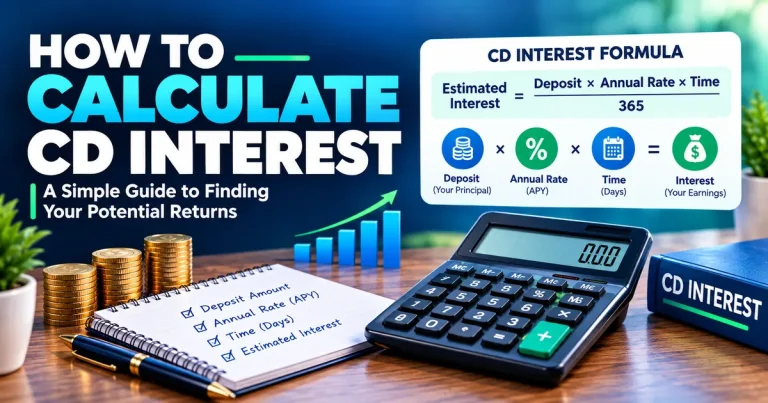
Before you start, find these details in the CD’s account terms. Knowing these numbers makes it easier to calculate CD interest and compare CD rates.
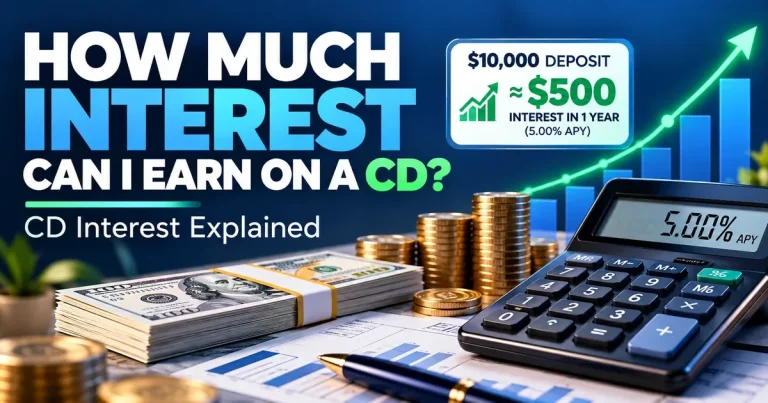
For example, suppose you deposit $10,000 into a one-year CD with a 4.00% APY. This is the basic setup used when you learn how to calculate CD rates.
Your starting balance is $10,000. The 4.00% APY tells you the annual yield under the account’s stated terms.
How to Calculate CD Rates Step by Step
When you want to know how to calculate CD rates, start with the information provided by the bank or credit union. Use the figures in the account disclosure rather than a rounded number from an ad.
Step 1: Find the deposit amount.
Start with the amount you plan to deposit.
For example:
$10,000 initial deposit
Step 2: Find the interest rate or APY
Check whether the account shows an interest rate, APY, or both. Do not treat the two numbers as identical. The interest rate is the stated rate. APY reflects the effect of compounding over a year.
Step 3: Check the CD term
You need the term for the calculation.
Common examples include:
For an estimate, you can convert months into years.
Step 4: Choose the right formula
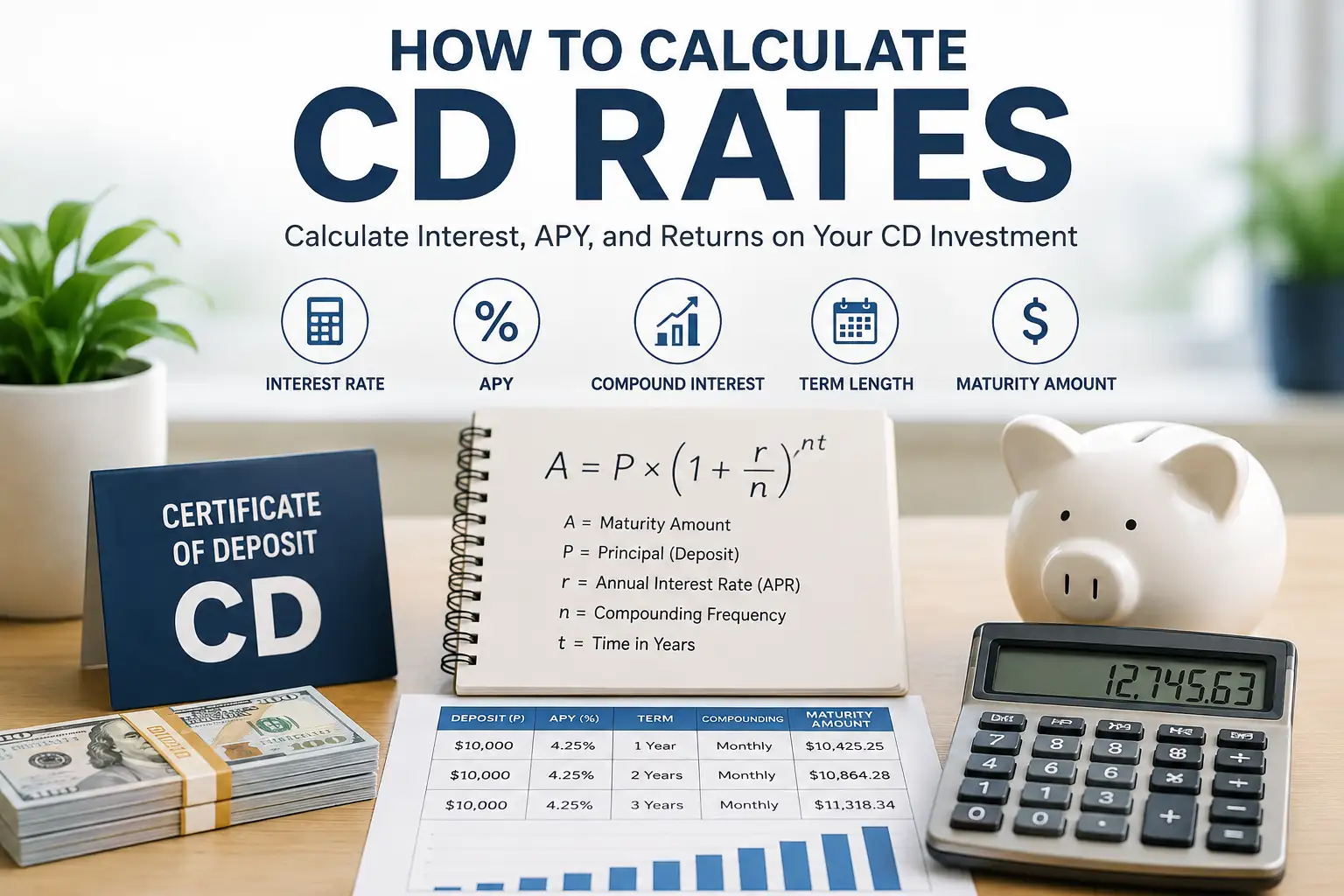
If you know the annual interest rate and the compounding schedule, you can use the compound interest formula:
A = P(1 + r/n)^(nt)
Where:
To find the interest earned:
Interest = A – P
This method works well when the account terms match the formula. It is a key part of how to calculate CD rates from the numbers in a disclosure.
How to Calculate CD Interest With an Example
Suppose you deposit $10,000 into a CD that pays a 4.00% annual interest rate, compounded monthly, for one year. This example shows how to calculate CD rates when the rate and compounding schedule are known.
Use these values:
The calculation becomes
A = 10,000(1 + 0.04/12)^(12 × 1)
The ending balance is about $10,407.42. This is your CD maturity amount under these assumptions. Your interest earned is about $407.42.
A simple 4.00% calculation would produce $400. Monthly compounding raises the result because each interest payment can earn interest during the term. Your actual CD may use different terms.
How to Calculate a CD Rate From APY
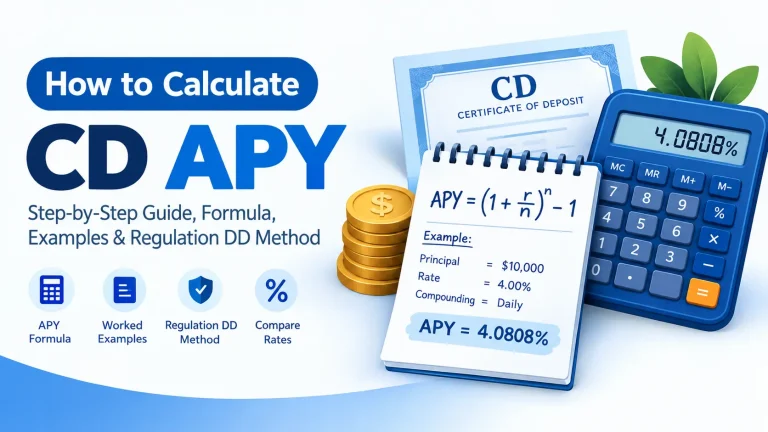
LYou may know the APY and want to estimate the underlying annual interest rate. This is useful when you are learning how to calculate CD interest rates from an advertised APY. When the compounding frequency is known, you can rearrange the APY formula:
APY = (1 + r/n)^n – 1
To solve for the annual rate:
r = n[(1 + APY)^(1/n) – 1]
For example, suppose a CD offers a 4.00% APY and compounds monthly.
The estimated underlying annual rate is about 3.93%.
This explains why the stated rate and APY may differ.
For a real account, use the figures and terms shown in the bank’s disclosure. This also helps when you want to know how to calculate a CD rate or how to calculate a CD rate of return estimate.
How to Calculate a CD Rate of Return
Your rate of return shows how much your investment gained compared with the original deposit. It answers another common question about how to calculate CD rate of return.
Use this formula:
Rate of return = (Ending balance – Initial deposit) / Initial deposit × 100
Suppose you deposit $5,000 and the CD earns $210 in interest.
($5,210 – $5,000) / $5,000 × 100 = 4.20%
Your return is 4.20% for the period measured. The same approach works for how to calculate a CD rate of return.
Do not call it a one-year return unless the period covers one year or you have annualized the result. The same rule applies when you calculate CD rates of return.
How to Calculate CD Interest for a Partial Year
Many CDs have terms shorter than one year. That matters when you calculate CD interest because the time period changes the result.
For a basic simple interest estimate, use:
Interest = Principal × Rate × Time
Suppose you put $8,000 into a six-month CD at a 4.00% annual rate.
$8,000 × 0.04 × 0.5 = $160
The estimated interest is $160.
Your actual earnings may differ if the CD compounds interest or uses a specific day count. These details matter when you calculate CD rates for real accounts.
Interest Rate vs. APY on a CD
Interest rate and APY are related, but they are not the same number.
| Term | What It Tells You |
|---|---|
| Interest rate | The stated annual rate used under the account terms. |
| APY | The annual yield that reflects the effect of compounding. |
| CD term | How long your money remains in the account. |
| Ending balance | Your deposit plus the interest credited under the account terms. |
APY can make CD offers easier to compare because it accounts for compounding. This difference also explains why a CD rate and a CD APY are not always the same number.
When comparing two CDs, also check the term, minimum deposit, interest payment rules, and renewal terms.
How Compounding Changes CD Earnings
Compounding determines how often earned interest is added to your balance. The CD compounding frequency can be daily, monthly, quarterly, or annual.
Common schedules include:
When interest stays in the CD, more frequent compounding can increase the amount you earn.
For example, $10,000 at a 4.00% annual rate for one year produces $400 with annual compounding. Under monthly compounding, the balance grows to about $10,407.42.
Check the account terms for crediting and compounding details.
How Much Interest Will a CD Earn?
Your earnings depend on the deposit, rate, term, and compounding method. This is the core of how to calculate the interest rate on a CD and estimate CD earnings. For a separate explanation, see How to Calculate CD Interest. It also helps answer how to calculate CD rates of return.
Here are simple comparison examples using annual compounding:
| Deposit | Rate | Term | Approximate Interest |
|---|---|---|---|
| $5,000 | 3.00% | 1 year | $150 |
| $5,000 | 4.00% | 1 year | $200 |
| $10,000 | 4.00% | 1 year | $400 |
| $10,000 | 4.00% | 2 years | $816 |
These figures assume the stated rate stays unchanged and interest compounds annually. This makes the example useful when you want to calculate CD rates without extra variables.
A real CD can produce a different result when it compounds more often or follows different account terms. Check those details when you calculate CD rates for a real offer.
What Happens to CD Interest at Maturity?
Maturity is the date when the CD’s term ends. Your CD maturity value depends on the starting deposit and the interest credited under the account terms. You can check the result with our CD maturity calculator.
What happens next depends on the account agreement. The bank may pay or credit interest during the term or keep the interest in the account until maturity. Some CDs renew automatically. Check the renewal terms before maturity.
Does a CD Rate Include Taxes?
The advertised CD rate does not show your after-tax return. For a broader comparison, you can also review the impact of an early withdrawal with our CD early withdrawal penalty calculator.
Interest from CDs is generally taxable income for federal tax purposes. The exact tax treatment depends on your situation and the account terms. Your after-tax amount can be lower than the interest shown.
How to Check Your CD Calculation
A CD calculator can help you check the math and compare different offers. Our CD comparison calculator is useful when two CD offers have different rates or terms. A CD interest calculator or CD rate calculator can also show how your CD balance changes when you change the deposit, rate, or term.
Enter the same details shown in the CD disclosure:
Compare the result with the bank’s disclosed figures.
How to Calculate CD Earnings for Different Terms
The same basic process works for six-month, one-year, and longer CDs. The main difference is the CD term length and the way interest is credited.
For example, a $10,000 deposit at 4.00% for one year earns about $400 with annual compounding. A 4.00% APY would produce about $400 for the same $10,000 deposit over one year because APY already reflects compounding.
When you compare bank CD rates, check the certificate of deposit rate, minimum deposit, CD account rules, and interest payment terms. A fixed rate usually stays unchanged during the CD term.
Frequently Asked Questions
Conclusion
Learning how to calculate CD rates helps you compare offers and estimate your potential earnings. It also makes it easier to check a CD rate calculation before you open an account.
Start with the deposit, rate or APY, term, and compounding schedule. Then use the formula that matches the account terms. This is a simple way to learn how to calculate CD rates. This is the basic method for how to calculate CD rates.
For a quick check, enter the same figures into a CD calculator and compare the result with the bank’s disclosed figures.