How to Calculate CD APY
When you compare certificates of deposit, you are usually looking at two numbers on the same page: an interest rate and an APY. The gap between them is not a marketing trick; it is the compounding, converted into a figure you can compare across banks. This guide shows you how to calculate CD APY by hand, how to do it for a CD shorter than a year, what formula US banks are legally required to use, and why two banks advertising the same rate can legitimately print different APYs. The worked examples follow the formula in Regulation DD, the rule your bank has to use rather than a simplified version of it.
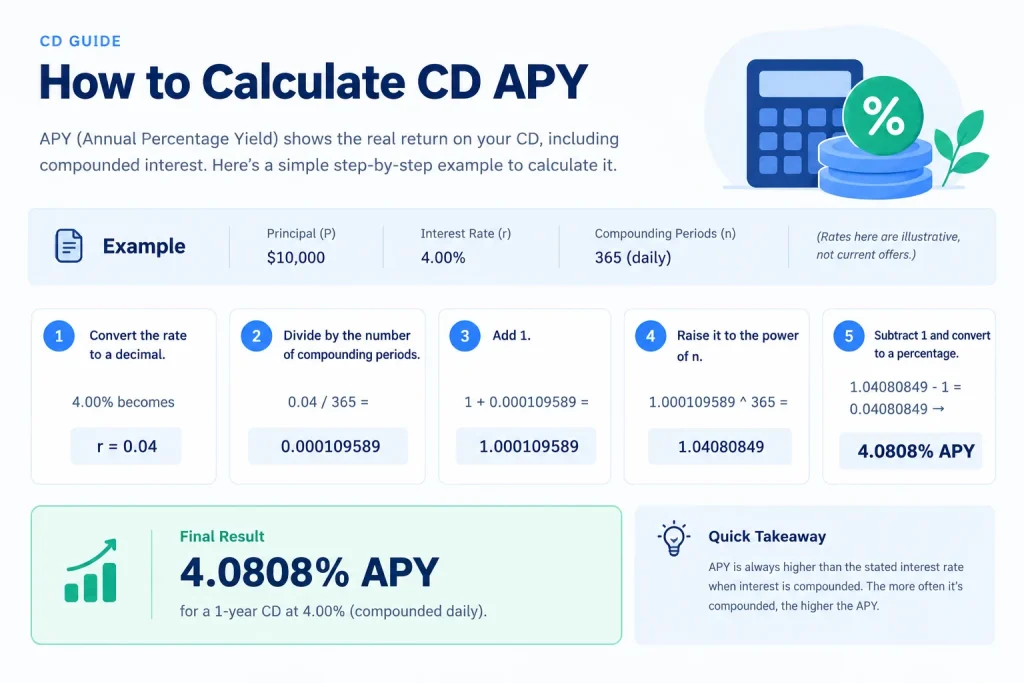
The short answer: APY = (1 + r/n)^n − 1, where r is the annual interest rate as a decimal and n is the number of times interest compounds per year. For a CD at 4.00% compounded daily: (1 + 0.04/365)^365 − 1 = 0.040808, or 4.0808% APY. If you would rather not do any of these calculations by hand, our CD APY calculator takes your deposit, rate, and compounding frequency and returns the same figure in one step.
What is APY on a CD?
Annual Percentage Yield (APY): Annual percentage yield is the overall growth of your money in one year with compounding included.The interest rate on a CD tells you the simple annual rate the bank applies. The APY tells you what you actually end up with after that interest is credited and then starts earning interest of its own. Because APY already contains the compounding, it is the only one of the two figures you can compare between two banks without doing further arithmetic.This is why the APY on a CD is almost always slightly higher than the stated rate and why a CD paying 3.95% compounded daily can beat one paying 4.00% paid once at maturity.
How can I calculate CD APY
Take a one-year CD of $10,000 at a 4.00% interest rate, compounded daily. (Rates here are illustrative, not current offers.)
On $10,000, that is $408.08 of interest in the first year, against $400.00 if the same 4.00% were paid once at the end. Daily compounding is worth $8.08 here, small, but it is the entire reason the two numbers on the bank’s page differ. A useful sanity check: over a full one-year term, no matter how often a 4.00% rate compounds, the APY cannot exceed e^0.04 − 1 = 4.0811%.
That is the mathematical ceiling for continuous compounding, so a one-year 4.00% CD advertised above it does not add up. (Shorter terms are a separate case; see the day-count section below.) Those five steps are exactly what our CD calculator runs for you for any deposit, rate, and term you enter.
What is 4% APY on a $10,000 CD?
Once a figure is quoted as an APY, the compounding is already baked in. You do not apply the formula again you simply multiply.
| CD | Interest in One Year | Balance After One Year |
|---|---|---|
| $10,000 at 4.00% APY | $400.00 | $10,400.00 |
| $1,000 at 5.00% APY | $50.00 | $1,050.00 |
| $10,000 at 3.75% APY | $375.00 | $10,375.00 |
| $100,000 at 4.00% APY | $4,000.00 | $104,000.00 |
The common mistake is to take an advertised APY and then compound it, which double-counts. A 4.00% APY on $10,000 returns exactly $400.00 in a year, not $408.08. The $408.08 figure belongs to a 4.00% interest rate compounded daily, which is a different product description. If the question behind your search is really how much interest can I earn on a CD, that is covered separately with figures across several balances and terms.
How do you calculate APY on a CD shorter than one year?
This is where most CD guides stop being useful, because the standard formula annualizes over a full year, and a six-month CD does not run a full year. The US banking system handles it by annualizing the actual interest in dollars per the actual number of days:
APY = 100 x [(1 + Interest/Principal)^(365/Days in Term) – 1]
Where:
Take $10,000 in a 182-day CD at a 4.00% rate compounded daily. Over 182 days it earns $201.44. Now annualize it:
APY = 100 x [(1 + 201.44/10,000)^(365/182) – 1]
= 100 x [(1.020144)^2.005495 – 1]
= 4.0808%
The same 4.08% as the one-year version, which is the point APY is deliberately built to let you compare a 6-month CD against a 5-year CD on one scale. What differs is the money: $201.44 over 182 days, not $408.08. A 4.08% APY on a half-year CD does not pay you 4.08% of your balance; it pays you roughly half of it, because you were only invested for roughly half a year. For a term that is not a round number of years, our CD interest calculator works from the actual day count instead of assuming a full year.
What formula are banks legally required to use?
In the United States, APY is not a marketing figure a bank can define for itself. It is a mandated disclosure under the Truth in Savings Act, implemented by the Consumer Financial Protection Bureau as Regulation DD (12 CFR Part 1030). The formula lives in Appendix A to Part 1030: APY = 100 [(1 + Interest/Principal)^(365/Days in Term) – 1]
The regulation defines its own terms:
Notice what the official formula does not contain: an interest rate or a compounding frequency. It works entirely from dollars of interest and days elapsed. That is why one formula can handle a CD that compounds daily, a CD that pays simple interest, and a CD whose rate changes halfway through. The familiar (1 + r/n)^n − 1 is really a convenient special case of it.
Appendix A includes a certificate of deposit example of its own. In case a bank calculates APY by paying $30.37 in interest on a $1,000 six-month CD and the bank uses 182 days for its six-month period, then the APY must be disclosed as equal to 6.18%: APY = 100 x [(1 + 30.37/1,000)^(365/182) – 1] = 6.18%
Worth knowing while you shop: the regulation also states that APY “reflects only interest and does not include the value of any bonus (or other consideration worth $10 or less). “So if a CD comes with a cash bonus for opening it, that bonus is not in the advertised APY. Your actual return is higher than the number on the page.
Why can two banks advertise the same rate but different APYs?
Because they are allowed to count the days differently. Regulation DD lets an institution offering a CD in multiples of months use either the actual number of days in the period or the number of days in any real sequence of that many calendar months. A “six-month” CD can therefore legitimately be counted as 181, 182, 183, or 184 days. Days in term sits in the exponent as 365 / Days in term. Change the number of days and you get a different APY number.
The regulation demonstrates this inside its own pages: its general CD example uses 182 days for a six-month CD, and its stepped-rate CD example uses 183 days for another one. The practical takeaway is small but real. When two CDs show the same rate and APYs that differ in the second decimal place, the difference may be a day-count convention rather than a better deal. Compare the dollar interest the bank discloses for the term, not just the APY.
How do you calculate APY on a CD that doesn’t compound?
Plenty of CDs pay simple interest or pay interest out to you monthly instead of leaving it on deposit. The answer splits into two cases, and they move in opposite directions.
Case 1: a CD shorter than one year that pays interest at maturity. Take $10,000 in a 182-day CD at 4.00% simple interest: 10,000 × 0.04 × (182/365) = $199.45. We annualize it by the prescribed formula; we see that the APY is 4.04%, while the stated rate is 4.00%, although there is no compounding going on. The reason is that annualizing a 182-day return to a 365-day scale compounds that return forward roughly twice.
Case 2 involves a CD with a maturity period longer than one year that pays out interest at least annually. DD Regulation has addressed this scenario directly; if the Time Account has a maturity period of longer than one year, which does not compound annually or more frequently, and if you withdraw the interest annually at least, then “the annual percentage yield may be disclosed as equal to the interest rate.” A two-year non-compounding CD at 6.00% paying you semi-annually can have an APY of 6.00%, equal to, not higher than, the stated rate.
So the same CD can show three different figures depending on how it is structured:
| $10,000, 182-Day CD, 4.00% | Interest Earned | Disclosed APY |
|---|---|---|
| Compounded daily | $201.44 | 4.08% |
| Simple interest, paid at maturity | $199.45 | 4.04% |
| Advertised as 4.00% APY | $197.49 | 4.00% |
How much difference does compounding frequency make?
Most articles assert that more frequent compounding earns more.The whole range is $8.11 on $10,000, and less than one basis point separates monthly from daily, 4.0742% against 4.0808%, or about 67 cents on a $10,000 deposit. Compounding frequency is a genuine tiebreaker between two otherwise identical CDs, but it is worth far less than a tenth of a percentage point of rate.
This also works in the opposite direction, and it is the more common mistake: a CD at 4.00% compounded daily (4.0808% APY) still beats one at 4.05% paid annually (4.0500% APY). You will need about 4.09% paid annually to beat it. Always compare APY, not rates. The dollar value, not the percentage value of this difference, is what the actual gain from compounding is worth to you. This is the topic of our guide on how to calculate CD interest.
APY, interest rate, and “APY Earned” — three different numbers
You will meet a third figure on account statements. Regulation DD Part II calls it the annual percentage yield earned, and it is calculated on your average daily balance for the statement period rather than on an assumed deposit:
APY Earned = 100 [(1 + Interest earned/Balance)^(365/Days in period) – 1]
In short: the interest rate is what the bank applies, the APY is what the rate is worth over a year with compounding under standard assumptions, and the APY earned is what your specific balance actually produced over a specific period. On a CD you never touch, the last two should be very close. If they are not, the usual cause is a deposit date mid-period, a partial withdrawal, or a rate change.
Frequently Asked Questions
Source
Consumer Financial Protection Bureau, Regulation DD Truth in Savings. Rates shown are illustrative and not current offers. For a benchmark on whether a given APY is competitive, compare against the FDIC‘s published national deposit rate averages.